
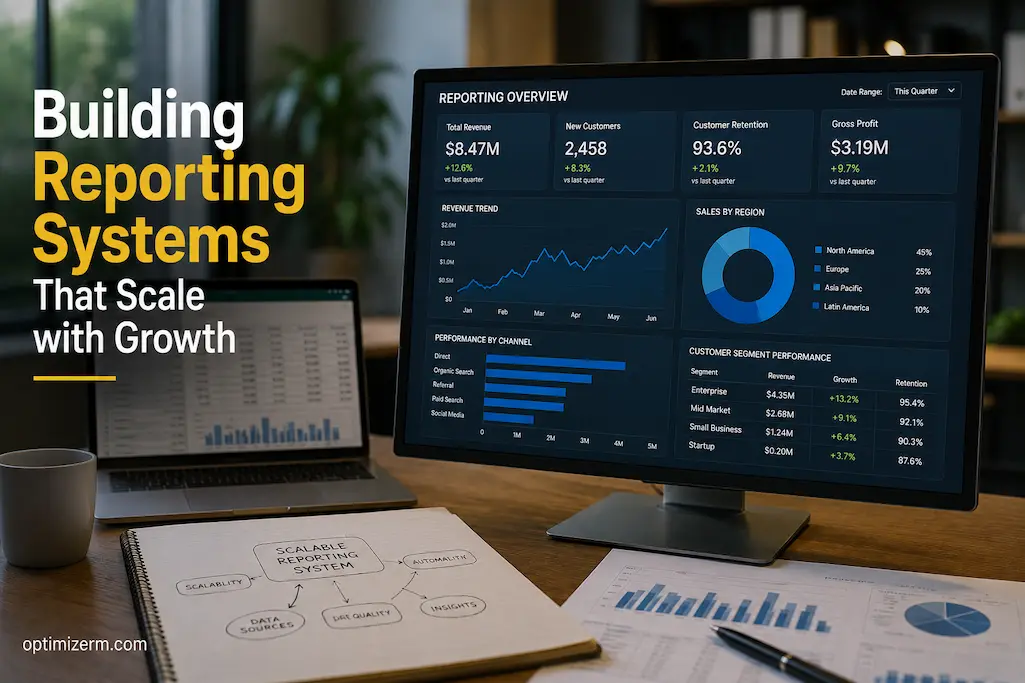
For small businesses, generating reports is usually straightforward. Sales managers export customer data from a CRM (Customer Relationship Management) system, the finance department uses a few spreadsheets, and department heads meet weekly to discuss financial figures. Because the sources of information are clear and few systems are involved in the final data entry, report generation is quick. At this stage, reports support daily operations without requiring significant time or technical resources.
As the company grows, many things change, albeit gradually. New products enter the market, new employees are hired, numerous departments manage their datasets, and customers interact with the company through more channels than ever before. Tasks that once took minutes—such as comparing reports—now take hours because different teams calculate the same metrics differently or rely on different data sources. The reporting software itself may be perfectly adequate, but if the reporting process fails to keep pace with the company’s growth, confidence in the data erodes.
A successful, scalable reporting system involves more than just the ability to handle larger volumes of data; it must remain reliable as business operations become more complex. As companies expand, reporting systems must continue to provide clear, consistent, and trustworthy information while preventing employees from spending ever-increasing amounts of time troubleshooting issues. Establishing such a system requires thorough planning before rapid expansion.
Growth Alters the Flow of Information
As companies grow, new opportunities arise, but this also changes the flow of information within the organization. Whether dealing with a company with just one office and a sales team or an organization with multiple locations and specialized departments, the changes in information flow vary drastically. Each additional employee, customer group, service, or operational system introduces more information that management must ultimately incorporate into reports.
It is not merely a matter of processing more data; more importantly, it is about ensuring data consistency as the number of people creating and using that data grows. If reporting processes do not scale alongside the organization, teams often develop their own methods for gathering information, generating reports, and defining KPIs. Over time, these subtle differences make it increasingly difficult to produce universally accepted reports.
More Teams, More Reporting Possibilities
As companies grow, reporting is no longer confined to just one or two departments. The marketing department assesses campaign effectiveness, sales tracks opportunities, customer service monitors satisfaction, finance oversees revenue, and operations checks service delivery. Each team provides valuable information, yet their understanding of business operations differs.
Without standardized reporting, these independent reporting channels gradually become disconnected. Departments might calculate the same metrics using different standards or rely on disparate, unsynchronized systems to generate results. Viewed in isolation, each report may appear correct. However, when combined, they can paint conflicting pictures of business performance, making it difficult for executives to make decisions.
New Business Challenges Driven by Growth
Expansion affects not only the content of reports but also the issues management aims to address through reporting. Some startups rely on simple operational metrics such as revenue, customer acquisition, or monthly costs. As companies grow, however, leaders seek insights into customer retention rates, regional performance, operational efficiency, product line profitability, and long-term trends.
Meeting these new reporting requirements involves more than simply increasing the number of charts and dashboards. As business operations become more complex, reporting systems must also evolve to ensure the organization, comparability, and meaningfulness of information. Companies that prepare for these new requirements in advance are generally better able to adapt to change than those that rush to overhaul their reporting systems after expanding.
Reporting Systems Should Mature Alongside the Business
Many companies still use reporting systems developed for much smaller businesses, simply because those processes worked well during the initial growth phase. Although traditional methods can still generate reports, these processes often become increasingly inefficient as the company expands. Employees spend a great deal of time creating spreadsheets, verifying data, and correcting errors, rather than analyzing performance or supporting strategic decisions.
Scalable reporting systems evolve in stages as the organization grows. Each stage brings new reporting requirements, improved management, and more efficient cross-departmental collaboration. Organizations do not need to completely overhaul their reporting processes as they grow; instead, they can gradually build systems capable of handling larger volumes of data without causing unnecessary disruption.
Early Growth Requires Visibility
In the early stages of a company’s development, reporting is primarily about transparency. Leaders want visibility into sales activities, customer acquisition, operating costs, and basic financial performance. Simplicity often beats complexity, as it gives employees quick access to reliable information, enabling faster decision-making during the company’s early days.
At this stage, the focus should be on the consistency of the reporting system rather than its complexity. While reporting itself is crucial, establishing clear definitions and processes early on lays a solid foundation for future development. Companies that develop effective reporting habits at this stage often avoid many operational issues later on.
Expansion Demands Coordination
As organizations grow, their workforces expand and functional areas become increasingly specialized. Consequently, reporting evolves into a collaborative process. “We now need to gather information from multiple business units, so coordination between reporting teams must be strengthened. If management requires reliable information, departments must agree on standardized definitions, consistent reporting schedules, and shared performance indicators.”
This stage often reveals shortcomings that previously went unnoticed. “Discrepancies in aggregated data may arise depending on which department generates the report, or manual data adjustments prior to executive meetings may become more frequent. As a result, growing companies need to recognize the importance of better coordinating reporting processes across the entire organization—and not merely for the sake of correcting errors in reports.”
Standardization Supports Growth Better Than Constant Software Changes
When reporting problems begin appearing, organizations sometimes assume new reporting software will provide an immediate solution. Although technology plays an important role, software alone cannot eliminate inconsistencies created by unclear processes or conflicting business definitions. Without standardized reporting practices, even advanced platforms simply process inconsistent information more efficiently.
Sustainable reporting systems are built around agreed standards that remain consistent regardless of which department creates the information or which technology stores it. Employees should understand how key business metrics are defined, how customer information moves between systems, and which procedures govern reporting across the organization. These shared standards allow businesses to expand without losing confidence in the information supporting important decisions.
Building Flexibility Into a Growing Reporting System
A reporting system that scales successfully does not remain unchanged for years. Instead, it is designed to adapt as business priorities, customer expectations, and operational structures evolve. New products are launched, departments take on additional responsibilities, and leadership begins asking questions that were never considered during the company’s early stages. If reports cannot accommodate these changes without major redesigns, the reporting process quickly becomes an obstacle instead of a business asset.
Flexibility, however, should never come at the expense of consistency. Organizations often make the mistake of creating separate reports every time a new requirement appears. Over time, dozens of similar reports begin circulating throughout the business, each containing slightly different calculations and assumptions. Employees spend more time determining which report is correct than using the information to make decisions. A scalable reporting system grows by extending an organized framework, not by creating isolated reports whenever new needs arise.
Modular Reporting Makes Expansion Easier
One practical way to support long-term growth is by thinking of reporting as a collection of connected building blocks rather than a single large system. Core business metrics—such as revenue, customer growth, retention, and operational performance—remain standardized across the organization. Additional reporting modules can then be introduced for specific departments, projects, or business initiatives without changing the underlying reporting structure.
This modular approach makes expansion considerably easier. When leadership requests a new operational report or a department introduces another performance indicator, organizations can build upon existing reporting standards instead of redesigning the entire reporting process. As the business continues growing, reporting remains organized because every addition fits within an established framework rather than creating another independent source of information.
Avoiding Duplicate Metrics Across Departments
Growth often encourages departments to create performance indicators that appear different but actually measure similar outcomes. Marketing may develop a customer engagement score while customer success tracks account activity using another calculation. Sales introduces its own customer health measure, and before long several reports attempt to evaluate the same business condition from different perspectives.
Reducing unnecessary duplication improves both reporting quality and organizational alignment. Rather than maintaining multiple versions of comparable metrics, businesses should identify shared measurements that can support decision-making across departments. This creates a common understanding of business performance while allowing individual teams to monitor the operational details most relevant to their responsibilities.
Reporting Should Help Decisions Happen Faster
As organizations expand, reporting can unintentionally become slower. More approval steps, additional spreadsheets, and repeated data verification often delay reports that leadership needs quickly. While maintaining accuracy is essential, reporting should also support timely decision-making. Information that arrives too late often loses much of its practical value, regardless of how detailed it may be.
Scalable reporting systems balance accuracy with efficiency by simplifying how information moves through the organization. Instead of requiring multiple manual reviews before reports are finalized, businesses establish processes that maintain data quality from the beginning. As confidence in reporting increases, executives spend less time questioning figures and more time discussing business strategy, customer needs, and future opportunities.
Reporting Should Encourage Collaboration
Reliable reporting is rarely the responsibility of one department alone. Sales contributes customer activity, finance validates financial performance, marketing measures engagement, operations tracks delivery, and customer support records service outcomes. Each team provides a different perspective, and those perspectives become significantly more valuable when they are connected through a shared reporting framework.
Organizations that encourage collaboration during reporting often experience fewer inconsistencies because departments understand how their information supports wider business decisions. Discussions also become more productive since teams focus on interpreting results instead of debating which report contains the correct numbers. Over time, reporting evolves from a technical process into a shared business capability that supports better planning across the organization.
Operational Habits That Help Reporting Scale
Technology contributes to scalable reporting, but everyday operational habits often determine whether reporting remains reliable as the business grows. Organizations that consistently maintain reporting quality usually share several practical characteristics.
- Establish common definitions for key business metrics across every department.
- Review reporting processes regularly instead of waiting for major problems to appear.
- Reduce manual spreadsheet adjustments wherever possible.
- Assign clear ownership for maintaining important business information.
- Document reporting procedures so they remain consistent as teams expand.
- Evaluate new reporting requests against existing standards before creating additional reports.
These habits may seem straightforward, yet together they reduce reporting complexity while allowing the system to adapt naturally as organizational requirements continue changing.
Reporting Priorities Change as Businesses Grow
The focus of reporting naturally evolves throughout different stages of business development. Understanding these changing priorities helps organizations strengthen reporting systems before operational complexity begins affecting decision-making.
| Business Growth Stage | Primary Reporting Priority |
|---|---|
| Startup | Visibility into daily operations and financial health |
| Growing Team | Consistency across departments and reporting processes |
| Multiple Departments | Standardized metrics and shared business definitions |
| Multiple Locations | Centralized reporting with reliable data integration |
| Mature Organization | Strategic forecasting and long-term performance analysis |
The objective is not to build the most advanced reporting system immediately. Instead, organizations should ensure that reporting capabilities mature alongside the business so future growth does not outpace the systems supporting it.
Conclusion
Scaling your reporting system as your business grows involves more than just selecting the right software or creating visually appealing dashboards. As your organization expands, your reporting system must evolve to accommodate new teams, processes, customer interactions, and business objectives. Organizations that invest in standardized definitions, collaborative workflows, and flexible reporting frameworks can build systems that remain reliable even as operational complexity increases.
The best reporting system is not the one with the most reports or the most complex visualizations, but rather one that consistently delivers clear, reliable information, regardless of how the business evolves. As internal reporting mechanisms mature, management can be confident that every critical decision is backed by accurate, consistent, and readily available information at the most crucial moments.
FAQs
1. When is a complete overhaul of a company’s reporting system necessary?
If a company expands into new departments, products, customer groups, or operational complexities—and existing reports no longer cover these aspects—the company needs to re-evaluate its reporting system. Generally, it is more difficult to implement improvements once problems have become widespread.
2. Is increasing the number of dashboards always the right solution?
Not necessarily. Too many dashboards can create complexity if they contain duplicate or conflicting information. Often, improving reporting standards is more beneficial for business growth than simply providing more visualizations.
3. Can a growing company still rely on spreadsheets?
Spreadsheets remain very useful for many day-to-day tasks, but as a company grows significantly, a more formal reporting approach is often required to ensure consistency across different teams and data sources.
4. Should all departments use the same reports?
No. Different departments require different operational insights, but they must use common business concepts and standardized key metrics to ensure report comparability across the entire organization.
5. How can a reporting system remain flexible as an organization grows?
A flexible reporting system—built on standardized processes, modular reporting structures, shared ownership, and regular evaluations—can meet new reporting needs without disrupting existing operations.
6. What is the most important characteristic of a scalable reporting system?
As business processes become more complex, a scalable reporting system consistently delivers accurate and timely information. It scales alongside your business, eliminating the need for frequent redesigns and resolving conflicting versions of business performance data.