
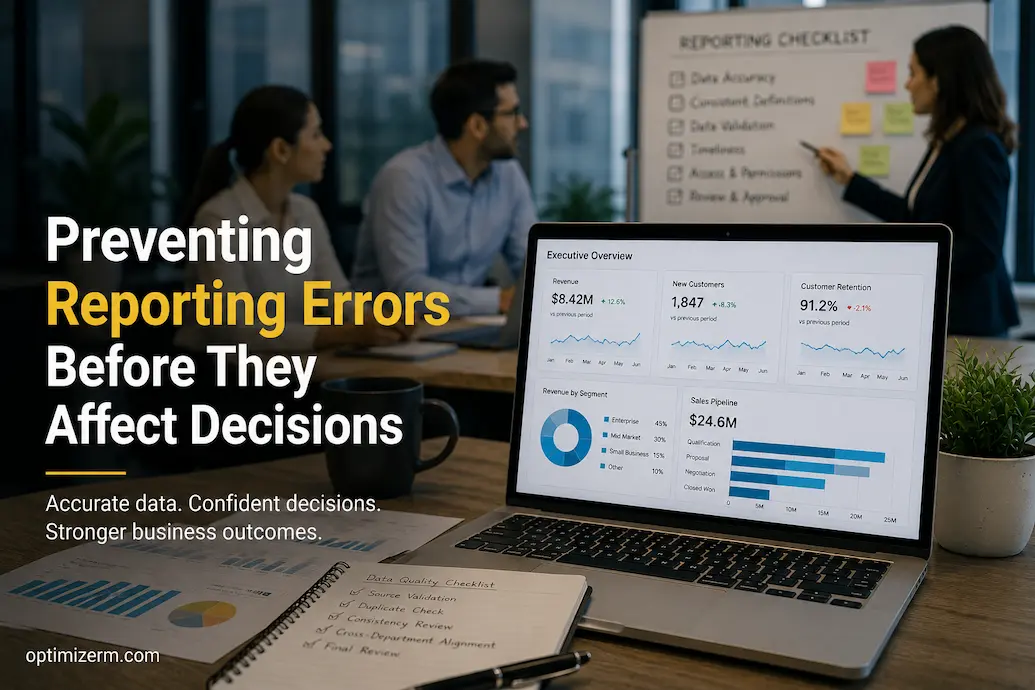
A report looks perfect—until the company actually starts using it.
A regional sales director reviews the quarterly overview in preparation for an upcoming planning meeting. The statistics show strong growth across sales channels, an increase in new customers, and stable renewal rates. Based on this data, management approves additional hiring, increases marketing spend, and sets higher sales targets for the next quarter.
Within a few weeks, however, that optimism fades.
There are duplicate sales opportunities in the pipeline, resulting in double counting. In other instances, inactive customer accounts appear as active. Ongoing contracts are excluded from renewal figures, and the method for counting leads differs between marketing reports and the CRM (Customer Relationship Management) system. These issues are difficult to detect because the reports look flawless and every chart displays a consistent pattern.
The problem lies not in the dashboard itself, but in the reporting process. “This situation occurs far more often than most organizations realize. Reporting errors rarely come to light only after glaring mistakes have been made; instead, they quietly influence planning meetings, budget decisions, resource allocation, and customer strategies until someone discovers that the underlying information is unreliable.
Therefore, the key to preventing reporting errors lies not in ‘correcting’ reports after they have been published, but in identifying vulnerabilities before incorrect information reaches decision-makers. Organizations committed to establishing accurate reporting processes spend more time leveraging data to improve business performance than critically scrutinizing the data itself.
Reporting Errors Usually Begin Long Before Reports Are Created
When discrepancies appear on dashboards, many teams immediately check the reporting software or analytics platform. However, the root cause of reporting errors often lies much earlier in the process.
Customer data passes through multiple systems before finally appearing on dashboards. Sales staff update the CRM system… Data is captured, marketing platforms synchronize campaigns, customer service applications track interactions, financial systems calculate revenue, and reporting tools consolidate all this information into business reports.
Small discrepancies can occur at any stage.
A missing customer status during data entry can be significant. Different departments may use different naming conventions. The operations team might find a synchronization delay of a few hours acceptable.
These issues rarely go unnoticed when they occur in isolation.”However, when these issues accumulate across thousands of customer records, they gradually affect performance reports, ultimately leading to business decisions based on incomplete or misleading data.
Our goal is not to find and correct every potential error (which is impossible for a growing company), but to develop mechanisms for identifying critical issues before reports are published.
Why Decision Makers Often Miss Reporting Problems
One reason reporting errors go unnoticed is that people tend to trust a polished presentation.
Interactive dashboards, attractive visualizations, and automatically generated reports create a false sense of accuracy. Readers often assume that the facts underlying the polished presentation have undergone the same rigorous scrutiny.
Unfortunately, visual quality and data quality are two different things.
A well-designed dashboard can effectively display both accurate and incorrect information.
Decision-makers often focus more on the impact on business operations than on reporting methodologies. Executive meetings typically cover revenue growth, customer retention, operational performance, and market potential. Many do not verify if departments used consistent definitions, if customer data was validated, or if delayed transactions were excluded from the reporting period.
As a result, reporting issues often only come to light when business performance begins to deviate from established targets.
The Small Inconsistencies That Become Major Reporting Problems
Serious reporting failures rarely begin with dramatic system outages. More often, they develop from routine operational inconsistencies that accumulate over weeks or months.
Different Teams Define the Same Metric Differently
Imagine two departments discussing “active customers.”
The sales team considers any customer with an open opportunity to be active. Customer success defines active customers based on product usage during the previous thirty days. Finance recognizes active customers only after completed payments.
Each definition may be reasonable within its own context.
However, when reports combine these numbers without clarification, leadership receives conflicting information that becomes increasingly difficult to interpret.
The issue is not inaccurate calculations but inconsistent business definitions.
Data Changes Faster Than Reports
Customer information evolves continuously.
Accounts change ownership, contracts are renewed, products are upgraded, and opportunities move through different sales stages. Reports generated from yesterday’s information may already be outdated before they reach management.
This task becomes particularly important during periods of rapid business activity such as product launches, seasonal demand increases, or major marketing campaigns.
Preventing reporting errors therefore includes understanding whether reports reflect the right information at the right time—not merely whether calculations are technically correct.
Manual Adjustments Create Hidden Risks
Many organizations still perform manual corrections before distributing executive reports.
Analysts export CRM data into spreadsheets, adjust classifications, remove duplicate records, combine information from several systems, and calculate additional performance indicators before preparing presentations.
Although these adjustments often improve report quality temporarily, they also introduce new risks.
Different analysts may apply different correction methods.
Documentation may be incomplete.
The same adjustment may not be repeated consistently during the next reporting cycle.
Over time, reporting becomes dependent on individual knowledge rather than standardized business processes.
Looking for Warning Signs Before Numbers Become Decisions
Organizations that consistently produce reliable reports rarely wait until executives question the numbers. Instead, they monitor indicators that suggest reporting quality may be declining.
One warning sign appears when departments spend more time discussing whose report is correct than discussing what actions should be taken. Frequent disagreements about customer counts, revenue totals, or pipeline values often indicate underlying data governance problems rather than isolated reporting errors.
Another indicator is the growing use of personal spreadsheets. When managers repeatedly export data to create their own calculations instead of relying on official reports, confidence in centralized reporting gradually weakens. While spreadsheets remain valuable analytical tools, stakeholders’ widespread use of them to verify existing reports may signal a lack of trust in the information provided.
Repeated last-minute report corrections deserve similar attention. If reporting teams consistently discover missing records, incorrect classifications, or unexpected variances just before executive meetings, the organization is likely correcting problems too late in the reporting process. Rather than focusing on analysis, teams spend valuable time repairing preventable issues.
These warning signs often appear long before inaccurate reports lead to poor business decisions. Recognizing them early helps organizations strengthen reporting processes and avoid losing confidence.
Building Validation Into the Reporting Process
Many businesses validate reports only after completing them. A more reliable approach introduces validation throughout the reporting workflow, allowing teams to identify errors before they reach dashboards or executive summaries.
Instead of treating validation as a final review, organizations benefit from incorporating simple checkpoints as customer information moves between operational systems and reporting platforms.
| Reporting Stage | Validation Focus | Primary Objective |
|---|---|---|
| Data entry | Required fields, formatting, duplicate detection | Improve record accuracy at the source |
| Data synchronization | Field mapping and transfer consistency | Ensure systems remain aligned |
| Report preparation | Metric definitions, calculation logic, reporting periods | Produce consistent business measurements |
| Pre-publication review | Variance analysis and trend comparison | Identify unusual results before distribution |
| Executive reporting | Context and business interpretation | Support confident decision-making |
This approach distributes quality checks across the entire reporting lifecycle instead of concentrating responsibility at the final stage. As a result, reporting teams spend less time resolving avoidable issues and more time interpreting business performance.
Creating Reports That Earn Trust
Accurate reports are valuable only if people believe them. Once confidence in reporting begins to decline, rebuilding that trust takes far longer than correcting a single error. Teams start requesting additional verification, comparing multiple reports before making decisions, and delaying actions until they are certain the numbers are correct. The reporting process gradually becomes slower, even though the technology itself has not changed.
Preventing this situation requires designing reporting systems that emphasize reliability as much as speed.
Make Consistency More Important Than Complexity
As organizations grow, reporting often becomes increasingly sophisticated. New dashboards are introduced, additional KPIs are tracked, and more filters are added to satisfy different departments. While these improvements can provide deeper analysis, they also increase the number of places where inconsistencies may appear.
A simpler report built on well-governed data often delivers more value than an advanced dashboard assembled from inconsistent sources.
Consistency should extend beyond the numbers themselves. Report titles, reporting periods, customer classifications, and metric definitions should remain stable so that users understand exactly what they are reviewing. Frequent changes to terminology or calculation methods make it difficult to compare performance over time, even if the underlying data is accurate.
Question Unusual Results Before Publishing Them
Unexpected performance is not always a reporting error. Sometimes it reflects genuine changes in customer behavior or business conditions. However, unusual results deserve careful examination before anyone distributes them.
For example, if customer acquisition suddenly increases by 40 percent within a single reporting period, analysts should investigate whether the change reflects a successful campaign, a modification in reporting criteria, duplicate customer records, or delayed data imports from another system.
Developing the habit of asking “Does this result make business sense?” helps identify issues that automated validation rules may not detect.
When Departments Share the Same Report but Reach Different Conclusions
Even when everyone is looking at the same dashboard, different interpretations can lead to different decisions.
A sales manager may focus on opportunity volume and conclude that the pipeline is healthy. A finance manager reviewing the same report may notice declining average deal values. Meanwhile, customer success leaders may recognize that several large accounts are approaching renewal without sufficient engagement.
All of these observations could be correct.
The challenge is ensuring reports provide enough context for readers to understand how different metrics relate to one another instead of encouraging isolated interpretation.
Adding supporting information such as historical trends, business assumptions, or metric definitions often prevents unnecessary debate. Rather than asking whose interpretation is correct, teams can concentrate on identifying the most appropriate business response.
Building Reporting Processes That Improve Over Time
A one-time improvement project does not achieve reliable reporting. As organizations expand, launch new products, adopt additional software, and enter new markets, reporting requirements naturally evolve.
The reporting process should evolve with them.
Successful organizations regularly evaluate whether their reports continue answering the questions leadership actually needs to address. Metrics that once influenced important decisions may become less relevant, while emerging business priorities may require new measurements or revised reporting structures.
This continuous refinement prevents reporting systems from becoming increasingly complicated without becoming more useful.
Equally important is documenting reporting processes. Clear documentation ensures that report preparation does not depend entirely on individual employees or undocumented spreadsheet logic. Standardized procedures improve consistency, simplify onboarding, and reduce operational risk when responsibilities change.
A Practical Review Routine Before Reports Reach Leadership
Rather than relying on lengthy audits at the end of each reporting cycle, organizations benefit from a short, structured review before reports are shared with decision makers.
| Review Question | Why It Matters |
|---|---|
| Have key metrics been calculated using the agreed definitions? | Prevents conflicting interpretations across departments. |
| Do current results align with recent business activity? | Helps identify unexpected reporting anomalies. |
| Have data imports and integrations completed successfully? | Reduces missing or incomplete records. |
| Are significant changes supported by business explanations? | Improves confidence in unusual results. |
| Have previous reporting issues reappeared? | Prevents recurring errors from becoming routine. |
These checks require relatively little time compared with the effort involved in correcting strategic decisions based on inaccurate information.
Strengthening Reporting Governance Without Creating More Administration
Governance is sometimes viewed as additional bureaucracy that slows reporting. In practice, effective governance often reduces unnecessary work because it minimizes repeated corrections and conflicting interpretations.
Clear ownership of reporting standards helps teams resolve questions quickly. Standard definitions prevent departments from creating competing versions of the same metric. Regular communication between operational teams helps identify process changes before they influence executive reports.
Governance should support reporting rather than complicate it. The objective is to establish enough structure that reports remain dependable while allowing teams to adapt as business requirements change.
Conclusion
Preventing reporting errors is far more effective than correcting them after business decisions have already been made. While reporting software plays an important role, the reliability of reports ultimately depends on the processes that collect, validate, interpret, and govern customer data throughout the organization.
Businesses that establish consistent definitions, validate information at multiple stages, and encourage collaboration across departments create reporting environments where decision makers can focus on strategy instead of questioning the numbers. Over time, this confidence improves the speed and quality of planning because discussions shift from verifying reports to acting on them.
The strongest reporting systems are not those with the most dashboards or the most advanced visualizations. They are the ones that consistently deliver accurate, well-understood information that leaders can rely on when making decisions that shape the future of the business.