
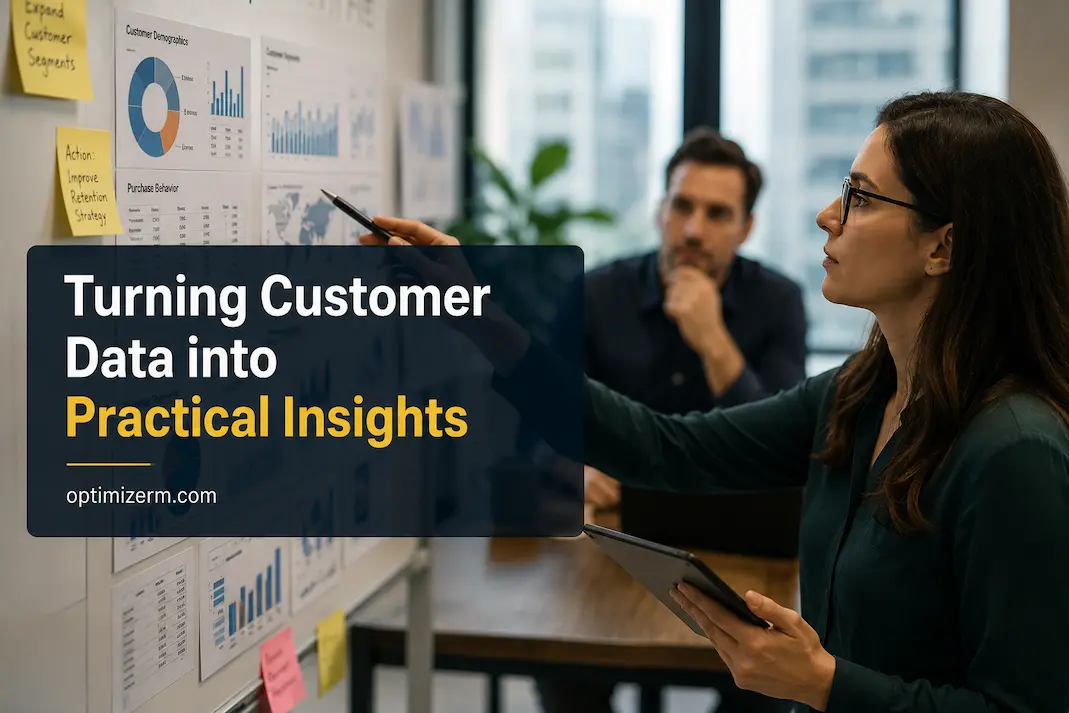
Every interaction with a consumer generates information. Whether it involves a website visit, a product purchase, service advice, sales negotiations, completing a survey, or renewing a subscription, it all contributes to a growing volume of consumer data. Modern CRM (Customer Relationship Management) systems and business applications continuously collect this information, giving companies insights into customer behavior that were previously impossible to obtain. However, despite this unprecedented volume of data, many companies struggle to translate it into decisions that improve performance.
The problem is rarely a lack of data. Rather, the key lies in understanding what the data conveys and how it should influence business strategy. Reports often tell you what consumers have done, but not why they did it or what you should do next. This leaves management teams overwhelmed by massive dashboards, unable to extract the truly valuable insights needed to strengthen customer relationships, optimize processes, or uncover new growth opportunities.
You gain actionable insights by analyzing customer data within the framework of business objectives. These insights help companies identify trends, anticipate issues, assess the impact of business activities, and make data-driven—rather than assumption-based—decisions. Instead of burying decision-makers under vast amounts of data, it is better to extract actionable insights, distill complex information, and highlight key areas of focus.
Transforming customer data into actionable information requires more than just complex analysis. It involves asking the right business questions, correctly evaluating information, and linking the results to actions that create genuine value. Companies with this capability are better equipped to respond to changing customer expectations and make more well-founded strategic decisions.
From Raw Customer Data to Business Intelligence
The more layers of filtering customer data passes through, the greater its value. Simply collecting data does not create business value. Companies create value by transforming fragmented data into knowledge, enabling better planning and decision-making.
Understanding the entire process helps explain why some companies consistently seem to gain valuable insights, while others generate countless reports but take little action.
Data is Just the Beginning
Raw customer data refers to a set of facts collected during interactions with customers.
This includes purchase data, support tickets, website visits, email interactions, contract values, account updates, and more. This data on its own offers only very limited information. A single support ticket or website visit typically does not tell you whether customer relationships are strengthening or how business performance is changing.
Raw data without interpretation is merely a series of unrelated events, not valuable business information.
Information Provides Structure
Sorting and grouping customer data is essential for extracting relevant information.
Managers can gain a holistic view by aggregating purchase data by customer segment, support inquiries by product, or grouping data by sales opportunity or sales pipeline stage. Information answers descriptive questions: What happened, when, and where?
This level of analysis improves the effectiveness of reports, yet companies still require further interpretation to make effective business decisions.
Insights Explain What Matters
Insights are more than just descriptions of customer activity. They characterize customer relationships, reveal relevant patterns, and highlight key areas for leaders to focus on. For example, a report might show a decline in the renewal rate among existing customers. The report provides insight. Further data indicate that the decline occurred primarily among customers who did not receive adequate support within the first 90 days.
The data constitute a performance report. The insights offer a plausible explanation and concrete business actions.
The Journey From Customer Data to Action
Organizations often assume insights appear automatically once enough data has been collected. In reality, practical insights emerge through a structured process that connects analysis with business objectives.
Each stage contributes to transforming customer information into decisions that improve performance.
Collect Reliable Customer Information
The quality of insights depends on the quality of the underlying data.
Customer records should be accurate, complete, and consistently maintained across CRM systems, marketing platforms, customer service applications, and other business tools. Duplicate records, missing information, and inconsistent definitions reduce the reliability of later analysis.
Strong data quality provides a dependable foundation for identifying meaningful business patterns.
Organize Data Around Business Questions
Collecting information without a clear purpose often produces reports that contain interesting statistics but limited practical value.
Instead, organizations should organize customer data around important business questions.
Examples include:
- Which customer segments are becoming less engaged?
- Where are customers leaving the sales process?
- Which services contribute most to long-term retention?
- What behaviors indicate increasing customer loyalty?
Organizing information around these questions ensures analysis remains connected to business priorities.
Analyze Trends Rather Than Individual Events
Customer decisions rarely depend on isolated transactions.
A single delayed support response may not indicate a broader problem. However, steadily increasing response times across several months may reveal operational challenges that require additional staffing or process improvements.
Trend analysis helps distinguish temporary fluctuations from sustained changes that deserve management attention.
Looking beyond individual events also reduces the risk of making decisions based on short-term anomalies.
Recognizing the Difference Between Information and Insight
Many reporting discussions use the terms information and insight interchangeably. Although related, they serve different purposes within business decision-making.
Information summarizes customer activity, while insights explain why that activity matters.
Consider the following example.
A report indicates that online purchases increased by 18 percent during the previous quarter. This is useful information because it describes business performance.
An insight might reveal that most of this growth originated from existing customers purchasing complementary products after receiving personalized recommendations. That understanding provides practical guidance for future marketing and customer engagement strategies.
The distinction is important because organizations make decisions based on insights rather than raw information.
| Level | Business Value | Example |
|---|---|---|
| Data | Individual facts | Customer placed an order on Tuesday |
| Information | Organized summary | Weekly online sales increased |
| Insight | Explanation of meaningful patterns | Returning customers responded strongly to personalized recommendations |
| Action | Business decision | Expand personalized recommendation campaigns |
This progression demonstrates why successful organizations invest as much effort in interpreting customer information as they do in collecting it.
Practical Insights Across Different Business Functions
Customer insights become significantly more valuable when applied to everyday business operations. Different departments rely on customer information for different purposes, but all benefit from analysis that supports better decision-making rather than simply describing historical performance.
Sales Teams
Sales leaders use customer insights to identify promising opportunities, understand buying patterns, and recognize where prospects encounter obstacles during the purchasing journey.
Rather than evaluating opportunity volume alone, practical insights reveal which activities consistently contribute to successful outcomes and where sales processes can be strengthened.
Marketing Teams
Marketing departments benefit from understanding how different customer segments respond to campaigns, content, and communication channels.
Instead of measuring campaign activity in isolation, insights help marketers evaluate customer engagement quality, conversion behavior, and long-term relationship development.
Customer Success and Support
Customer success teams rely on insights to recognize early warning signs that may indicate declining customer satisfaction or increasing churn risk.
Patterns such as reduced product usage, repeated support requests, or changing engagement behavior often provide opportunities for proactive intervention before relationships deteriorate.
By identifying these patterns early, organizations improve both customer experiences and long-term business performance.
Building a Culture That Values Customer Insights
Generating valuable insights is not solely the responsibility of analysts or business intelligence teams. Organizations gain the greatest benefit when employees across departments understand how customer information supports better decisions.
This requires more than providing access to dashboards. Teams need to understand which questions customer data can answer, how to interpret findings responsibly, and when additional investigation is necessary before taking action.
Encourage Cross-Functional Collaboration
Customer data often tells only part of the story when viewed from a single department’s perspective.
For example, marketing may identify declining campaign engagement, while customer support notices an increase in product-related inquiries during the same period. Sales teams may simultaneously report longer purchasing cycles for similar customer segments.
Individually, these observations appear unrelated. When examined together, they may reveal a broader customer experience issue affecting multiple stages of the customer journey.
Sharing insights across departments helps organizations develop a more complete understanding of customer behavior and supports decisions that address root causes rather than isolated symptoms.
Validate Insights Before Acting
Not every pattern represents a meaningful business trend.
An unexpected increase in customer complaints could result from a temporary service interruption, a seasonal demand spike, or changes in reporting methods. Acting immediately without validating the underlying causes may lead to unnecessary operational changes.
Organizations should compare findings with historical performance, review related business metrics, and consider recent operational events before implementing significant strategic decisions.
Careful validation increases confidence while reducing the likelihood of responding to misleading signals.
From Insight to Business Improvement
Insights create value only when they influence business actions. Many organizations successfully identify customer trends but struggle to translate those findings into measurable improvements.
Establishing a structured process helps ensure insights lead to meaningful outcomes rather than remaining interesting observations within reports.
Prioritize Opportunities Based on Business Impact
Customer analysis often identifies multiple opportunities for improvement. However, attempting to address every issue simultaneously can dilute resources and slow progress.
Leaders should evaluate opportunities according to factors such as customer impact, implementation effort, operational risk, and strategic importance. Prioritizing improvements enables organizations to focus on initiatives that deliver the greatest business value while maintaining realistic implementation plans.
Measure the Results of Business Decisions
Insights should initiate a continuous improvement cycle rather than ending with a single decision.
After implementing a new onboarding process, modifying customer communications, or introducing service improvements, organizations should monitor relevant KPIs to determine whether the expected outcomes have been achieved.
This ongoing evaluation strengthens future decision-making because teams learn which initiatives consistently improve customer relationships and which require further refinement.
Comparison: Data, Reports, and Practical Insights
Understanding how these concepts differ helps organizations avoid confusing reporting activity with genuine business intelligence.
| Focus | Primary Purpose | Typical Outcome |
|---|---|---|
| Customer Data | Records customer interactions | Individual facts and transactions |
| Business Reports | Organizes and summarizes information | Visibility into business performance |
| Practical Insights | Explains patterns and business meaning | Better understanding of customer behavior |
| Business Actions | Applies insights to decision-making | Improved processes, experiences, and results |
This progression highlights that reports are an important step, but practical value emerges only when organizations interpret information and apply it to real business decisions.
Common Mistakes When Interpreting Customer Data
Many organizations collect high-quality customer information yet still fail to generate meaningful insights because of weaknesses in analysis and interpretation.
Assuming More Data Automatically Produces Better Insights
Collecting additional information does not necessarily improve decision-making.
Large datasets can introduce unnecessary complexity if they are not connected to clear business questions. Teams may spend considerable time reviewing reports without identifying findings that influence strategic decisions.
Focusing on relevant information often produces better outcomes than continuously expanding the volume of available data.
Searching Only for Expected Results
Confirmation bias can influence business analysis.
When teams examine customer data expecting to confirm existing assumptions, they may overlook findings that challenge current strategies or reveal emerging opportunities.
Approaching analysis with curiosity rather than predetermined conclusions encourages more balanced decision-making and improves organizational learning.
Ignoring Business Context
Customer behavior rarely changes without reason.
Economic conditions, product updates, competitive activity, seasonal demand, and organizational changes can all influence customer trends. Interpreting data without considering these factors increases the risk of drawing incomplete or misleading conclusions.
Effective insights combine quantitative analysis with practical business understanding.
Measuring Success Only by Report Production
Some organizations evaluate reporting initiatives based on how many dashboards or reports are created.
A more meaningful measure is whether reports consistently improve planning, strengthen customer relationships, or support better operational decisions. The value lies not in producing reports but in enabling informed action.
Best Practices for Generating Practical Customer Insights
Organizations that consistently transform customer data into valuable business intelligence typically follow a disciplined analytical process.
- Begin every analysis with a clearly defined business question.
- Maintain accurate and consistent customer data across systems.
- Evaluate trends instead of relying on isolated observations.
- Combine quantitative findings with operational context.
- Validate significant insights before implementing major decisions.
- Share findings across departments to build a broader understanding of customer behavior.
- Measure the impact of decisions informed by customer insights.
- Continuously refine analytical processes as business priorities evolve.
These practices help ensure customer data becomes a strategic resource rather than simply a growing collection of information.
Frequently Asked Questions
What are actionable customer insights?
Actionable insights are customer patterns worth noting that help companies make specific business decisions. They provide leaders with enough context to identify the actions they need to take and to understand why those actions could improve results.
What is the difference between customer insights and reports?
Reports organize and summarize information. Insights analyze that information to explain its business relevance. Reports tell you what happened; insights help explain why it happened and what the company should consider next.
Are customer insights useful for small businesses?
Yes. Organizations of all sizes can make better decisions by studying customer behavior, identifying trends, and applying those findings to sales, marketing, customer service, and customer retention. The scale of the analysis may vary, but the fundamental principles remain the same.
How often should customer insights be evaluated?
The frequency of evaluations should depend on business needs. Operational insights may need to be evaluated weekly or even daily, whereas strategic trends are typically evaluated monthly or quarterly to support long-term planning.
Why do companies sometimes miss important insights?
Important insights are often overlooked when companies focus exclusively on predetermined metrics, evaluate departments in isolation, or fail to identify changes in consumer behavior beyond routine reporting.
How do you build an insight-driven organization?
The first step is identifying key business problems. Once you identify decisions that need improvement, you can collect relevant data, analyze patterns, and gain insights that directly support these goals.
Conclusion:
Customer data is only useful if it helps companies make better decisions. While collecting and organizing information is an important first step, thoughtful analysis, interpretation, and a clear understanding of business objectives are essential for gaining actionable insights. Companies that go beyond merely reporting historical data learn more about customer behavior and can respond more effectively to changing needs and market conditions.
Leveraging customer data to gain valuable insights also requires teamwork, reliable information, and a willingness to challenge existing assumptions. High-quality data, systematic analysis, and continuous evaluation help companies discover relevant opportunities, improve customer relationships, and boost operational efficiency.
The goal is not to generate more reports or collect more information, but to create insights that lead to confident, fact-based decision-making and generate lasting value for consumers and businesses alike.