
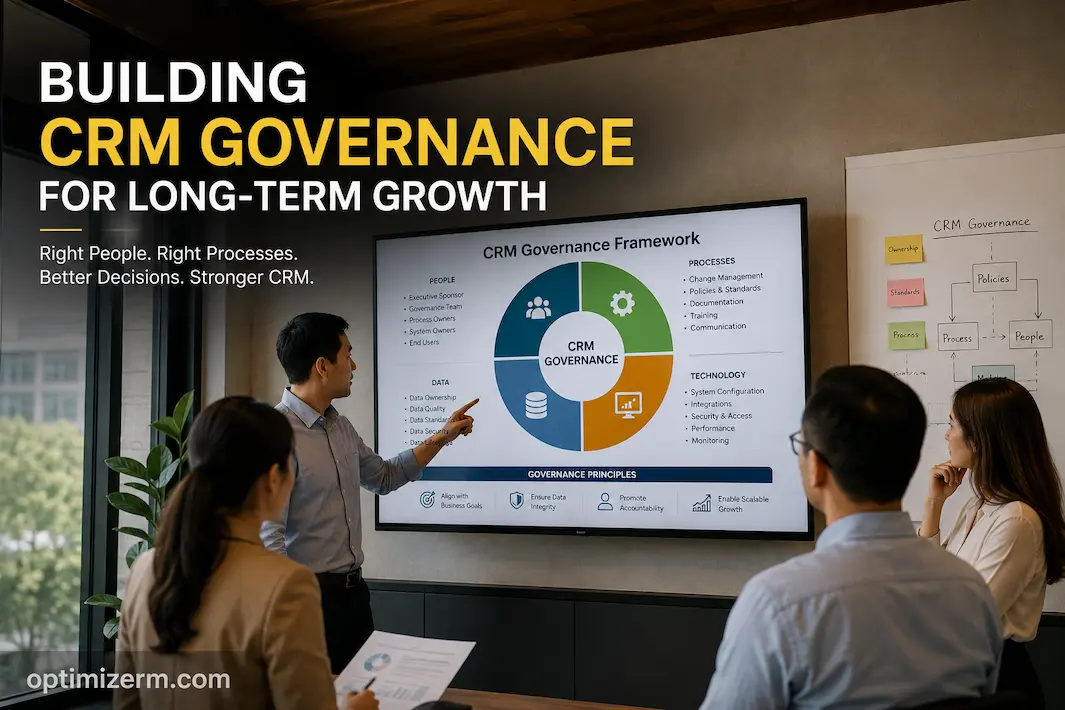
A CRM system may function perfectly at launch, yet years later, it can still cause significant operational issues. Employees may continue to log their activities, the software may remain stable, and the company might even add new dashboards, connectors, and automation features. However, beneath this seemingly stable façade, duplicate fields accumulate, ownership becomes blurred, access control turns chaotic, customization proliferates, and different teams begin using the same CRM system in different ways.
In this context, CRM governance becomes crucial. An extra layer of management labeled “governance” should not hinder changes to the CRM system. Well-implemented governance helps the company determine who is authorized to modify the CRM system, what needs changing, why changes are necessary, and how to manage the impact of those changes.
This is particularly important for long-term growth. A CRM system supporting 20 employees can often withstand informal decision-making because everyone is familiar with the functionality. However, once the company expands to include multiple teams, regions, products, integrations, and customer segments, coordinating these informal decisions becomes extremely difficult. Governance provides a consistent approach that ensures the CRM system aligns with business objectives while simultaneously fostering its evolution.
The CRM System Should Not Remain Static
Treating the initial CRM configuration as immutable is one of the most common pitfalls in governance. Companies change rapidly, and this strategy simply does not work.
Companies may alter customer lifecycles, add service channels, acquire other businesses, reorganize sales territories, or launch new products. Any change can be a valid reason to modify the CRM system. The challenge of governance lies not in preventing these changes, but in preventing them from happening spontaneously.
Therefore, the fundamental concept behind a sound governance model is simple: CRM changes should be intentional, not unintentional.
This distinction is crucial because many CRM issues stem not from a single major error, but from the accumulation of countless subtle choices. For instance, a frequently used field proves cumbersome, so someone creates a custom field; or another department adds a new customer category. To resolve an urgent issue, an administrator tweaks a workflow. A manager requests a dashboard displaying data that is already available elsewhere.
Individually, these choices may seem logical. Yet, combined, they can lead to costly and chaotic system management.
Give Decisions an Owner Before You Need One
Clearly defining roles and responsibilities before conflicts occur can significantly simplify management.
Not all business decisions need to fall directly under the CRM administrator’s authority. Business teams understand how customer processes actually work, whereas administrators understand the system’s configuration and technical limitations. Likewise, requiring senior management approval for every change to a field or workflow is unreasonable.
A practical governance structure can divide responsibility across several levels:
| Responsibility | Typical Owner |
|---|---|
| Business priorities | Executive sponsor |
| CRM standards | CRM governance group |
| Technical configuration | CRM administrator or platform team |
| Department requirements | Business process owners |
| Data quality | Data owners and operational teams |
| Security and access | IT/security and designated managers |
| Major changes | Governance group with business approval |
The exact titles will vary by organization. What matters is that employees know where different decisions belong.
This also prevents a common problem in growing organizations: the person who happens to know how to change something becomes the person who decides whether it should be changed. Technical capability and business authority are not the same thing.
Create a Change Process That People Will Actually Use
A governance process that requires five meetings to approve a minor field adjustment will eventually be bypassed. Employees will find shortcuts, and the organization will lose visibility into changes.
The alternative is not eliminating control. It is creating different levels of review based on risk.
A minor interface adjustment may need a simple administrator review. A change to a sales-stage definition could require sales operations approval because it affects reporting. A modification to customer data retention, security permissions, or a critical integration may require substantially more scrutiny.
This risk-based approach makes governance practical.
Before approving a significant CRM change, reviewers should be able to answer a few basic questions:
What business problem does this solve?
Who will be affected?
Which existing processes could change?
What data, automation, reporting, or integrations depend on it?
How will the organization know whether the change worked?
These questions discourage configuration changes made simply because someone prefers a different screen or field name. They also create a useful record of why important decisions were made.
The Best Governance Rule May Be Knowing What Not to Customize
CRM platforms offer enormous flexibility. That flexibility is useful, but it creates a temptation to recreate every existing business process inside the system.
Organizations often customize the CRM because their current process is familiar, even when that process is inefficient. Over time, the platform becomes increasingly difficult to upgrade, integrate, train, and maintain.
Before adding customization, governance teams should ask whether the requirement can be addressed through an existing CRM capability or a simpler process change.
This does not mean standardization should always win. A business may have legitimate requirements that justify custom objects, fields, automation, or integrations. The important distinction is whether the customization solves a meaningful business need.
A useful governance principle is:
Customize when the business requirement justifies the long-term cost of customization—not simply because the platform allows it.
Every customization creates a maintenance responsibility. Someone will eventually need to understand it, test it, document it, modify it, or remove it.
Data Governance Cannot Be Separated From CRM Governance
A CRM may contain millions of customer attributes, but the system cannot determine which information is correct without organizational rules.
Who owns a customer record? Who decides what counts as an active customer? Which team can change an account classification? How should duplicate records be handled? What happens when information conflicts between the CRM and another system?
These are governance questions, not merely technical questions.
A data owner should be accountable for important categories of customer information. That person or team does not necessarily perform every update, but they establish expectations for accuracy and help resolve ambiguous situations.
Data governance should also define standards for critical fields. If customer status is essential to sales reporting, for example, the organization should establish accepted values and explain when each value should be used.
Without these rules, the CRM gradually becomes a collection of individual interpretations. Two employees can enter perfectly reasonable information according to their own understanding and still produce data that cannot be reliably compared.
Treat Integrations as Part of Governance
A CRM rarely operates alone once a company begins to scale. Marketing platforms, customer service systems, accounting software, ecommerce platforms, communication tools, analytics systems, and data warehouses may all exchange information with it.
Each integration creates another opportunity for inconsistency.
If an external system changes a customer field automatically, who owns that value? If two systems contain conflicting information, which one is authoritative? What happens when an integration fails? Who notices? Who is responsible for fixing the problem?
These questions should be answered before integrations become business-critical.
A simple integration register can document each connection, its purpose, data exchanged, system owner, failure-monitoring method, and business impact. This becomes particularly valuable when employees responsible for an integration leave the organization.
Governance should also discourage unnecessary integrations. Connecting every application to the CRM because an integration is technically available can create a fragile network that becomes difficult to troubleshoot. Every connection should have a clear purpose and an accountable owner.
Permissions Need Governance, Not Just Configuration
Security settings can become outdated even when they were correctly designed at the beginning of implementation.
Employees change roles. Teams reorganize. Contractors join and leave projects. New CRM features introduce new capabilities. A permission model that made sense two years ago may no longer reflect the organization’s current responsibilities.
Governance should therefore establish how access is reviewed and who is responsible for approving changes.
This does not mean manually checking every permission every week. Instead, organizations can define review requirements based on risk. Privileged accounts, sensitive customer information, export capabilities, and administrative permissions generally deserve more attention than ordinary operational access.
The governance team should also monitor recurring access exceptions. If employees repeatedly request the same permission outside their standard role, the problem may not be the employees. The underlying role structure may need to change.
Keep a Record of Why the CRM Looks the Way It Does
Documentation is one of the least exciting parts of CRM governance and one of the most valuable during periods of growth.
A future administrator should be able to understand why an important workflow exists, why a particular field is mandatory, why a system integration owns a certain data value, or why a specific security restriction was introduced.
Without that information, organizations become dependent on individual employees who remember the history of the system.
Documentation does not need to become an enormous manual. For important CRM components, record the purpose, owner, dependencies, and reason for the decision. Significant changes should also include implementation dates and relevant approval information.
This creates organizational memory.
It also makes acquisitions and employee transitions easier. When new people join the CRM team, they can understand the environment without reconstructing years of decisions through trial and error.
Governance Should Measure System Health, Not Meeting Attendance
A governance committee can meet every month and still fail to govern the CRM effectively.
The better question is whether governance is preventing problems and helping the system support business growth.
Useful indicators might include the number of unnecessary customizations, unresolved data-quality issues, inactive integrations, overdue access reviews, recurring permission exceptions, failed automation incidents, or CRM changes that were implemented without documented ownership.
The measurements should remain focused. The goal is not to create another dashboard full of administrative statistics.
For example, if the number of duplicate customer records is increasing despite a data-quality policy, governance has identified a problem worth investigating. If custom fields are being created faster than they can be reviewed, the organization may need stronger change controls.
These indicators show whether governance is actually influencing the health of the CRM.
Make Governance Strong Enough for Growth but Light Enough for Speed
The right governance model for a 30-person company will not necessarily work for a 3,000-person organization.
As the business grows, governance often needs to become more structured because there are more stakeholders, systems, and consequences. But adding approval layers to every decision can make the CRM slower to adapt.
A scalable approach is to establish guardrails rather than bureaucracy.
Employees should know which changes they can make independently, which require business-owner approval, and which require formal governance review. Standard requests should have straightforward processes, while high-impact changes should receive deeper analysis.
This creates an environment where the CRM can continue evolving without becoming a free-for-all.
The same philosophy applies to experimentation. Teams should be able to test improvements in controlled environments without immediately changing production processes. A sandbox or development environment can allow CRM teams to evaluate new workflows, automation, and configurations before they affect live customer operations.
When Governance Is Working, Employees Barely Notice It
Good governance does not feel like a constant series of approvals. Employees should experience it indirectly through a CRM that remains understandable, reliable, secure, and aligned with their work.
They should know where to request changes. They should understand who owns important customer information. They should not encounter five versions of the same field because different departments created their own solutions. They should be able to trust reports because definitions are consistent.
That is a much better measure of governance quality than the number of policies written.
The National Institute of Standards and Technology’s governance guidance around cybersecurity similarly emphasizes defining organizational responsibilities, accountability, and decision-making rather than treating governance as a purely technical exercise.
A Practical Governance Review for a Growing CRM
Rather than waiting for a major CRM problem, organizations can periodically examine the system through a few practical questions.
Ownership: Can someone clearly explain who owns every important customer-data domain?
Configuration: Which customizations are still necessary, and which exist only because nobody has reviewed them?
Data: Are critical customer fields complete, consistent, and maintained according to defined standards?
Security: Do current permissions match employees’ responsibilities?
Integrations: Does every important integration have an owner and a documented purpose?
Processes: Are CRM workflows still aligned with how the business actually operates?
Documentation: Could a new administrator understand the most important CRM decisions without interviewing several former employees?
Change: Is there a practical process for introducing improvements without allowing uncontrolled configuration?
These questions provide a useful health check without turning governance into a theoretical exercise.
CRM Scalability Relies on Governance
While a CRM system can theoretically support more users, records, workflows, and connectors, that does not automatically make it scalable; internal organizational standards must evolve alongside the platform.
Without governance, growth often leads to a proliferation of exceptions. Administrators quickly add changes, managers request specialized reports, new teams create their own fields, and integrations introduce conflicting customer data. Ultimately, the company spends more time maintaining the CRM system than improving the processes it was originally intended to support.
Effective management can prevent this gradual decline without freezing the system. It clarifies responsibilities, ensures data quality, standardizes access rights, evaluates the level of customization, oversees integration, and establishes a sensible path for change.
A completely static CRM system is not a viable long-term goal. An ideal CRM system should be adaptable without becoming overly complex.
When management is based on this philosophy, an organization gains more than just a set of rules; it gains a consistent approach to maintaining its customer management infrastructure in alignment with business expansion, evolving business needs, and operational realities.
Frequently Asked Questions
Is CRM governance suitable only for large enterprises?
No; even small businesses—which may not require formal governance—can benefit from transparent ownership, data standards, access guidelines, and a process for deciding on changes. Implementing basic processes early on helps prevent more complex governance issues later.
Who should be responsible for CRM governance?
To align CRM decisions with business objectives, those in charge need sufficient organizational authority. Depending on the organization, this role might be filled by a cross-functional governance team, a business systems manager, a sales operations executive, or the head of CRM.
How often should CRM governance meetings take place?
The schedule will vary by organization. Meeting frequency should align with the pace of CRM changes and the level of business risk. Some companies manage routine governance through asynchronous processes and regular strategic reviews, while others benefit from monthly reviews.
Do all CRM modifications require approval?
Not always. Low-risk modifications can often be managed using established standards. Greater scrutiny should be applied to high-impact changes involving data structures, security, integration, report definitions, or significant automation.
What should be done if departments cannot agree on CRM standards?
Instead of letting the person with the most technical influence make the call, resolve disputes based on the organization’s governance model. When making decisions, consider factors such as customer impact, business goals, data integrity, operational costs, and long-term maintainability.
Does CRM governance stifle innovation?
Ineffective governance certainly will. Effective governance should actually encourage low-risk changes while focusing on those that could significantly impact business operations or security.